







Money Clarity: A Calm, Practical Reset for Women Who Feel Behind
You can be smart, successful, and still feel completely behind with money.
Maybe your income looks good on paper, but your savings don’t reflect it. Maybe you’re carrying quiet debt no one knows about. Or you’re just tired of feeling like you “should” have it together by now.
This isn’t a character flaw. It’s a clarity problem, not a worthiness problem.
Let’s walk through a calm, practical reset you can do without spreadsheets, shame, or perfection. Just honest numbers, simple decisions, and small moves that add up.
Step 1: Define what “enough” looks like for you
Feeling behind usually comes from comparing your life to someone else’s highlight reel. Before you touch the numbers, decide what you actually want your money to do for you.
Take five quiet minutes and answer, in a sentence or two each:
- Stability: What would make you feel safe month to month? (Examples: never worrying about rent, a 3–6 month cushion, paying cards in full.)
- Freedom: What choices do you want money to give you? (Examples: changing jobs, moving cities, taking a sabbatical.)
- Joy: What do you want to spend on without guilt? (Examples: travel, wellness, family support, creativity.)
This is your personal definition of “enough.” You’re not chasing someone else’s lifestyle; you’re building your own foundation.
Step 2: Get a calm snapshot of your money
Overwhelm thrives in the unknown. Clarity is neutral. Numbers are just information.
Grab a notebook or notes app. No fancy system. Write three lists:
- 1. What’s coming in (monthly)
Salary after tax, side income, support payments, anything consistent. - 2. What must be paid (monthly)
Rent or mortgage, utilities, minimum debt payments, childcare, insurance, groceries, transport. - 3. What you’re choosing (monthly-ish)
Eating out, shopping, subscriptions, beauty, wellness, travel savings, gifts.
Don’t try to be perfect. Round to the nearest 10 or 50. The goal is a clear picture, not accuracy to the cent.
Then ask yourself:
- Is more money leaving than coming in?
- Is there a small gap you can redirect toward savings or debt?
- Or are you roughly breaking even and feeling stuck?
Whatever the answer is, it’s data. Not a verdict on you.
Step 3: Sort your money into three simple buckets
Instead of a complicated budget, use three mental buckets for every dollar that comes in:
- Bucket 1: Now – Your current life: bills, food, transport, basic comfort.
- Bucket 2: Safety – Short-term security: emergency fund, paying down high-interest debt.
- Bucket 3: Future – Long-term you: retirement accounts, investments, big future goals.
Most women who feel “behind” are over-funding the Now bucket (to keep life running and looking fine) and under-funding Safety and Future.
You don’t have to overhaul everything. Start by shifting a small, specific amount into Safety and Future each month.
For example:
- $50–$100 to a simple emergency fund until you reach one month of expenses, then keep going.
- $50–$100 extra toward the highest-interest debt.
- 1–5% of your income into retirement (or increasing your current contribution by 1–2%).
The exact numbers matter less than the habit of consistently paying your Safety and Future selves first.
Step 4: Create a “non-negotiable minimum” plan
When you’re busy and emotionally stretched, complicated plans fall apart. You need a simple baseline you can keep even in chaotic seasons.
Decide on your non-negotiable minimums for each bucket:
- Now: The minimum you need to keep life functioning without panic. (Rent, food, transport, basic bills.)
- Safety: A small, automatic transfer to savings or debt, even if it’s $25 per paycheck.
- Future: A set retirement or investment contribution that happens automatically.
Then automate as much as possible:
- Automatic transfers to savings the day after payday.
- Automatic payments for minimum debt plus any extra you’ve chosen.
- Automatic retirement contributions through your employer or an individual account.
Automation removes willpower from the equation. You don’t have to feel motivated every month; the system runs in the background.
Step 5: Face debt without spiraling
If you’re carrying debt, especially credit cards, it can quietly drain your energy and confidence. You don’t need to clear it overnight. You just need a clear, kind plan.
List your debts with:
- Balance
- Interest rate
- Minimum payment
Then choose one of two simple strategies:
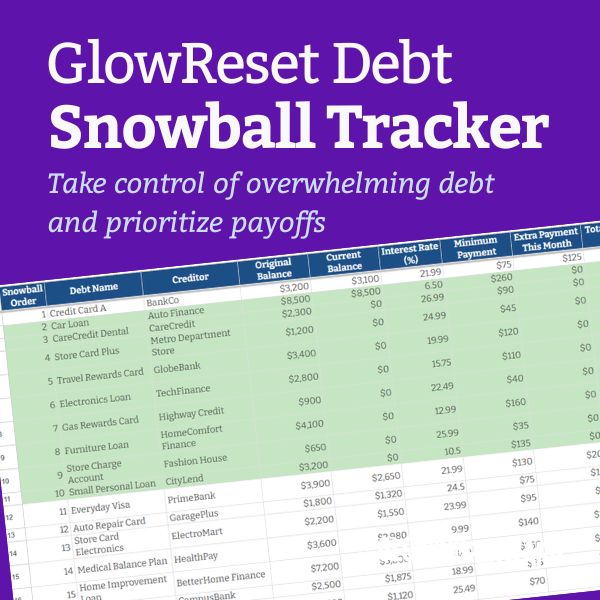
- Highest interest first (debt avalanche): Mathematically smartest. Pay minimums on all, then put any extra toward the highest interest rate.
- Smallest balance first (debt snowball): Emotionally motivating. Pay minimums on all, then put extra toward the smallest balance to get quick wins.
Pick the method that feels more sustainable, not the one that sounds more impressive. Consistency beats intensity.
If your minimums already feel unmanageable, that’s not a failure; it’s a signal. It may be time to explore options like refinancing, consolidating, or speaking with a nonprofit credit counselor for neutral, practical support.
Step 6: Build a calm relationship with spending
Many high-achieving women use spending as pressure relief: a treat after a hard week, a way to feel in control, or a way to keep up with a certain image.
Instead of judging your spending, get curious about it.
For one week, before any non-essential purchase, pause and ask:
- Is this soothing me, numbing me, or genuinely supporting me?
- Will I still be glad I spent this in 48 hours?
- Is there a version of this that costs less but still feels good?
If you still want it, buy it without guilt. The goal isn’t restriction; it’s awareness. Over time, this awareness naturally shifts your choices without harsh rules.
Step 7: Protect your future self in small, powerful ways
You don’t need a full financial plan to start protecting your future. A few simple moves create real stability:
- Emergency fund: Aim first for $500, then one month of expenses, then three. Celebrate each milestone.
- Retirement: If your employer matches contributions, try to capture the full match. It’s part of your compensation.
- Basic protections: Make sure you know what insurance you have through work (health, disability, life) and whether it’s enough for your situation.
These steps are quiet, invisible to others, and deeply powerful. They’re how you move from “I hope I’ll be okay” to “I’m actively building okay.”
Step 8: Release the timeline pressure
You might be thinking, “I should have done this years ago.”
Maybe. But you’re doing it now. And now is the only place you can actually change anything.
Your path might not look like your friends’, your coworkers’, or your parents’ expectations. That doesn’t make it wrong. It makes it yours.
Progress can look like:
- Checking your accounts weekly without dread.
- Paying one card down by even $200.
- Setting up your first automatic transfer to savings.
- Asking one honest money question you used to avoid.
None of this requires you to become a “finance person.” It just asks you to show up for yourself in small, consistent ways.
You are not behind. You are exactly where your next right step can happen.
Pick one action from this article—just one—and do it within the next 48 hours. Not perfectly. Just honestly.
Your money doesn’t need a makeover. It needs your attention, your clarity, and your willingness to start where you are.



